Herringbone parquet remains a timeless flooring choice because it gives an interior character without relying on a passing trend. Its geometric arrangement creates rhythm, guides the eye and adds visual depth. The pattern works in both traditional homes and contemporary spaces, provided the material, plank dimensions and laying direction are carefully considered.
What is herringbone parquet?
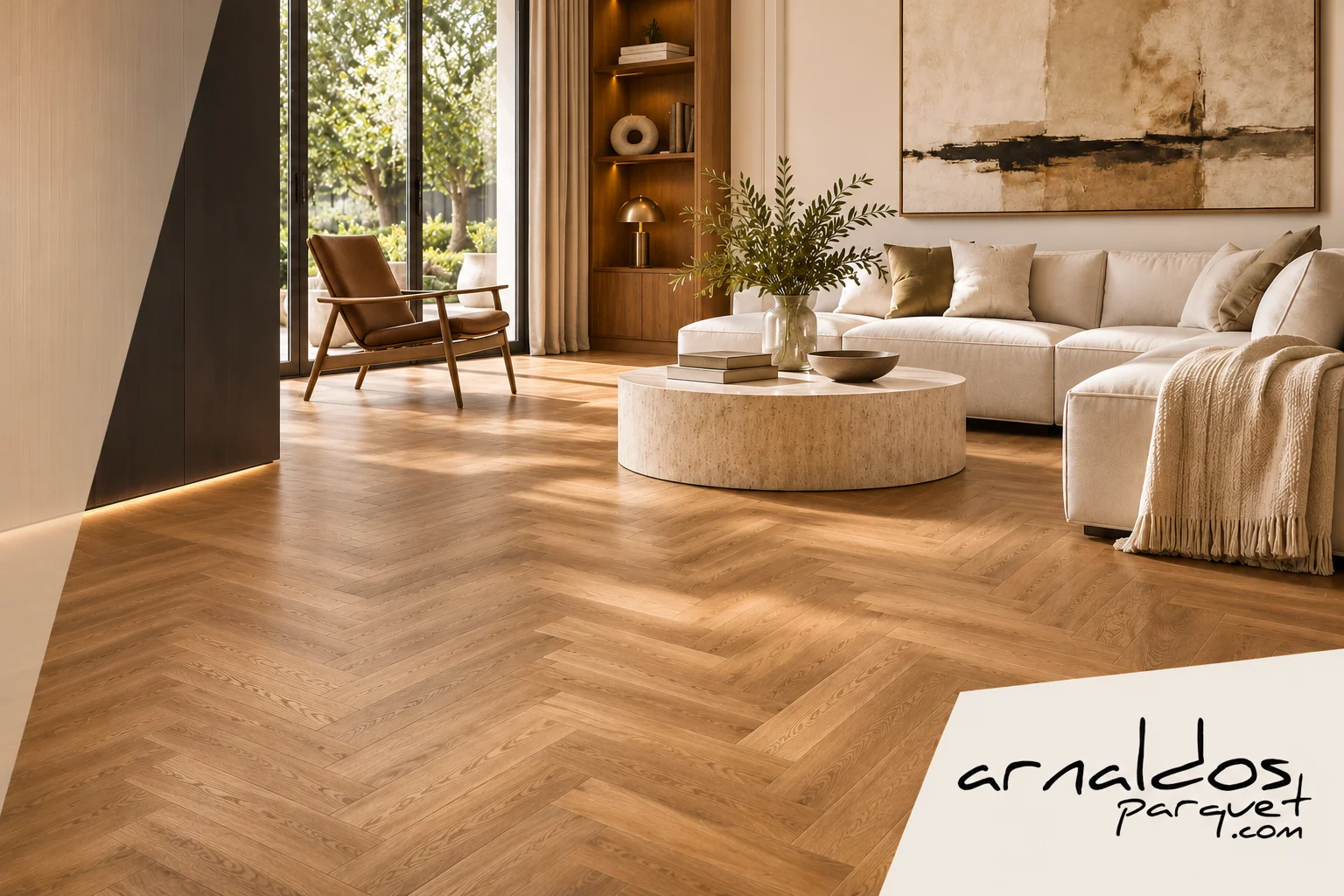
Herringbone is a flooring pattern created by arranging rectangular blocks or planks at right angles to one another. The resulting design forms a continuous, interlocking zigzag that resembles the bones of a fish.
The pattern has a long history in European interior architecture. Traditionally associated with wood parquet, it is now used in a variety of flooring materials and contemporary design projects.
Unlike a conventional straight-plank floor, herringbone has a distinct visual direction. Its geometry becomes part of the architectural composition rather than simply providing a neutral surface.
Why herringbone flooring never loses its appeal
1. It creates movement without excessive decoration
Straight-laid floorboards tend to provide a relatively calm visual background. Herringbone introduces a recognisable geometric rhythm that draws attention even when the furniture and surrounding decoration are understated.
This allows a room with plain walls, simple materials and minimal furniture to develop a distinctive identity without relying on additional decorative features.
2. It adapts to different architectural styles
In traditional interiors, herringbone can complement decorative mouldings, period joinery and symmetrical room layouts.
In contemporary spaces, the same arrangement can introduce warmth and texture alongside minimalist furniture, uninterrupted wall surfaces and large windows.
The atmosphere changes considerably depending on the colour, surface finish and proportions of the planks. A softly finished natural oak floor produces a different impression from a dark, high-contrast herringbone design.
3. It highlights the character of the material
The alternating direction of the planks makes grain patterns and colour variations an integral part of the floor's appearance.
In natural wood, individual boards may display subtle differences that add richness to the overall design.
However, a strong geometric arrangement combined with pronounced colour variation can create a busy appearance. Choosing a more consistent tone may help achieve a quieter, more balanced interior.
Traditional herringbone vs chevron: what is the difference?
Although these patterns are visually related, their construction is different.
Traditional herringbone uses rectangular pieces arranged perpendicular to each other. The end of each plank meets the side of another, creating a staggered zigzag.
Chevron, sometimes called French herringbone, uses planks with angled ends that meet to create continuous V-shaped lines.
Traditional herringbone has a more interwoven appearance, while chevron produces a sharper and more linear geometric effect.
Both can work beautifully, but each requires compatible products and installation methods. A standard rectangular flooring plank cannot automatically be used to reproduce every chevron design.
Does herringbone flooring work in small rooms?
Yes. Herringbone can be effective in compact spaces, provided the scale of the pattern is appropriate for the room.
Smaller blocks produce a more detailed geometric arrangement. Larger planks create a broader pattern with fewer visible intersections across the same area.
In smaller rooms, lighter finishes and limited colour contrast may create a more understated effect while retaining the characteristic movement of herringbone.
Careful planning of the cuts along walls, doorways and fixed architectural features is particularly important. The final layout should be considered as a complete composition rather than simply starting from one corner.
How laying direction changes the perception of a space
The orientation of a herringbone floor can influence how the room is perceived.
Depending on the layout, the pattern may lead the eye towards a window, seating area or architectural focal point. In other spaces, aligning it with the main entrance may produce a more coherent arrangement.
Natural light also affects the result. It can emphasise the joints, wood grain and subtle differences in surface texture.
There is no single correct laying direction for every room. The decision should take into account the overall floor plan, circulation routes, natural light and continuity between adjoining spaces.
Does herringbone flooring have to be natural wood?
No. Although herringbone has a strong historical association with wood parquet, the pattern is now available in different flooring materials.
Natural wood parquet
Natural wood provides authentic grain, individual colour variations and the distinctive character of real timber.
Depending on its construction and the thickness of the wear layer, some wood floors can also be renovated through refinishing.
One example available from Arnaldos Parquet is Quick-Step Disegno Roble Crudo, a natural wood parquet with a herringbone pattern.
Herringbone laminate flooring
Laminate flooring offers another way to achieve a herringbone appearance. Wear resistance, moisture protection and maintenance requirements depend on the specific product.
For example, Finfloor Espiga Orleans offers a natural-toned interpretation of the traditional pattern.
Another option is Finfloor Espiga Dijon, which provides a different colour treatment.
It is important to distinguish between flooring made from individual pieces designed for herringbone installation and products whose decorative surface simply reproduces the appearance of the pattern.
What to consider before installing herringbone parquet
Herringbone installation demands careful planning. Small alignment errors can become increasingly visible as the geometric pattern extends across the floor.
Before laying begins, the subfloor must be assessed for moisture, flatness and suitability. Reference lines should be established, and the pattern should be planned around walls, doorways and other fixed elements.
Installation methods vary between products. Some wood parquet systems require adhesive bonding, while certain engineered or laminate collections use locking mechanisms specifically designed for herringbone layouts.
Expansion requirements, acclimatisation and compatibility with underfloor heating must also be checked against the individual manufacturer's instructions.
Planning the installation alongside the product selection is usually the most effective way to avoid unnecessary complications and achieve the intended visual result.
A classic does not have to look traditional
A timeless design is not one that always looks the same. It is one that can evolve with different interiors while retaining its distinctive identity.
Herringbone continues to appeal because its geometry combines order, movement and texture. In a subtle finish, it can look calm and understated. With stronger contrast, it becomes a defining feature of the room.
Arnaldos Parquet offers natural wood and laminate flooring options with different patterns and finishes. If you are considering herringbone flooring, our team can help you compare materials, dimensions and installation requirements. Contact Arnaldos Parquet to discuss your project.
What is the difference between herringbone and chevron flooring?
Traditional herringbone uses rectangular planks arranged at right angles. Chevron uses planks with angled ends that meet to form continuous V-shaped lines.
Is herringbone parquet suitable for small rooms?
Yes. Its suitability depends on plank dimensions, colour, laying direction and room proportions. Careful planning can create a balanced pattern even in a compact interior.
Is herringbone parquet more difficult to install?
It generally requires particularly accurate planning, alignment and cutting. The installation procedure depends on the material and the manufacturer's specified fixing or locking system.
Can laminate flooring have a herringbone design?
Yes. Some laminate flooring collections offer herringbone designs. Check whether the pattern is formed by individual compatible planks or reproduced on the decorative surface.